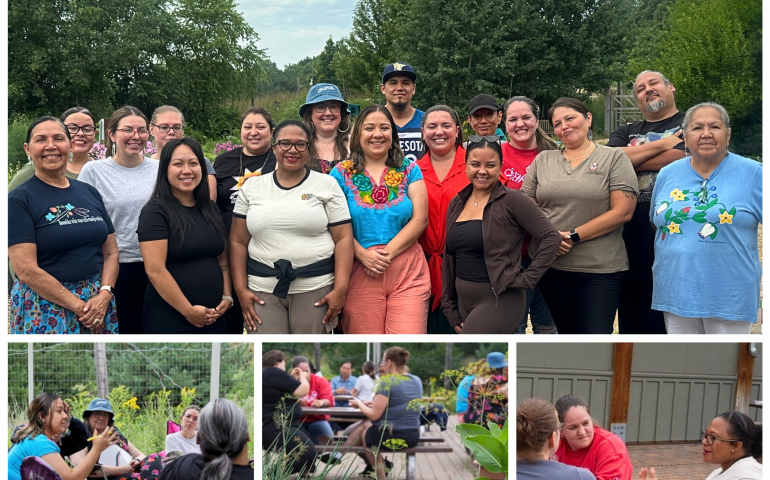
The LinkingLeaders Partnership is a coalition strengthening solidarity for racial justice and equity through a cross-racial, cross-cultural partnership in the Twin Cities. Bringing together more than 5,500 leaders in the region’s Black, Asian, Latine, and Native communities, LinkingLeaders seeks to identify strategies and best practice models to create connections and strengthen ties amongst leaders of color.
Made up of the Tiwahe Foundation, African American Leadership Forum, Coalition of Asian-American Leaders, and LatinoLEAD, the network approaches the practice of solidarity through a lens of leadership development, movement building, and network weaving. The Mortenson Family Foundation has supported this initiative since 2022.
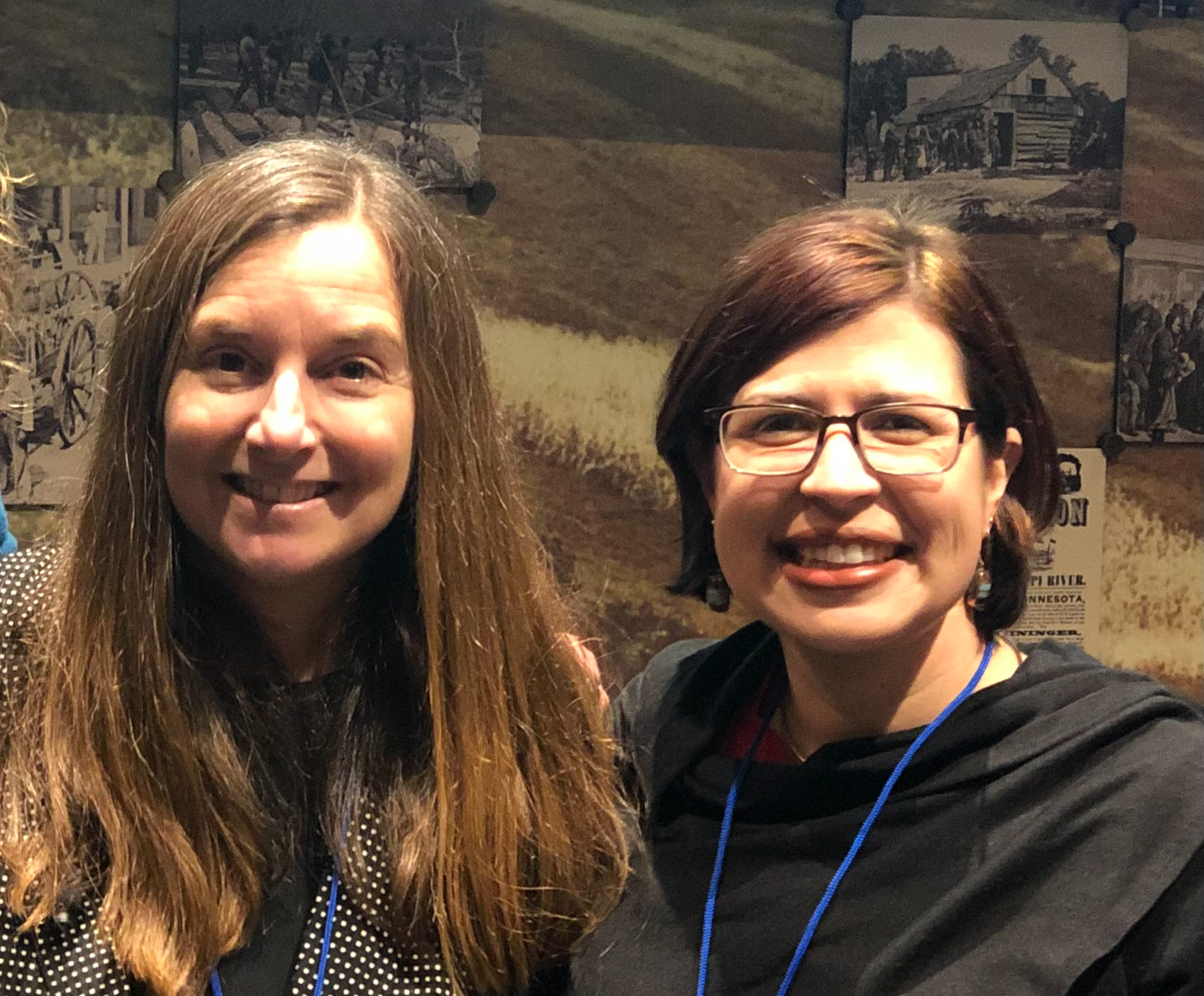
To get a better understanding of how these groups approach solidarity, we spoke with the Tiwahe Foundation’s Nikki Love (Pieratos) (Bois Forte Anishinaabe) and Baswewe Gayle (Bad River Band of Lake Superior Anishinaabe). Nikki is the organization’s Executive Director and Baswewe is the Oyate Leadership Network Director.
This partner story is part of a four-part series featuring the LinkingLeaders Partnership. This Q&A has been edited for clarity and length.
When a crisis hits—whether that’s political, social, environmental, or something else—what does solidarity look like in practice? Can you share moments where you’ve had to show up for others, or when others have shown up for you?
Nikki & Baswewe: A year or so ago, when our Managing Directors joined us on this journey, we asked each other to reflect again on our “Why?” In the midst of what seems like continual crisis in all of our respective communities, what is the true value of LinkingLeaders and coming together? At Tiwahe Foundation, we responded, “Because we know our collective liberation is bound together, especially for us as less than two percent of the state and national population. The number one challenge we as Native people face is invisibility or lack of meaningful visibility.” We also want to deeply understand the experiences and heart positions of other communities. What motivates and inspires them? How does their joy flourish? What are their deep underlying hurts? What do they wish other Black, Brown, and Native communities knew about them and how can we be better relatives to them?
With LinkingLeaders, solidarity is not just about showing up during crises, it’s about being in sustained relationships. We lean into the trust we’ve built across communities. Rather than reacting out of pressure, we choose to center care, and accountability to our relationships. It’s about being present and responsive, not reactive, and staying in the work when no one’s watching. In practice, solidarity is raw, real, grassroots, time-intensive; it’s not empty rhetoric. It’s when the urban Native community shows up for our Black relatives in marches, bringing resources and visibility to addressing endemic police violence, and healing ceremonies. It’s when Black Lives Matter movement leaders take the time to visit with Native leaders to share with us lessons on how to create a global metanarrative for Land Back, as part of the same cause and goal as reparations. Solidarity is when our Latine immigrant families march for justice in the streets of Minneapolis and all of our communities join alongside them against illegal deportations. Or, when we come together to address anti-Asian hate language in our schools amidst the pandemic. It’s when our organizations advocate for Education for All, not forgetting that Indigenous education for all is included. There are countless examples and our LinkingLeaders family has been at the center of it all.
Most importantly, solidarity in practice is alive when it’s in and out of the spotlight, being able to deeply emote, vent, cry, and imagine new future possibilities together. With DEI and racial equity efforts under attack and performative collaborations that are attractive to the media and funders everywhere, real practice is when no one is looking. How do your partners show up when the dollars aren’t pouring in, when what you’re doing isn’t popular or trending? Who’s still there?
Looking back on the work you’ve done together, what are some key lessons or realizations you’ve had? How has this journey shaped the way you think about collaboration, community, or even yourselves?
Nikki & Baswewe: One of the reigning assumptions is that Black, Brown, and Native people are part of one large brown rainbow. We are naturally expected to completely understand each other, working in seamless and effortless unity. Philanthropy seems to champion collaborations that uphold this appearance, because it’s easier than addressing the distinct needs and worldviews of our individual communities, none of which are homogenous themselves. Real solidarity takes realness, trust over time, and vulnerability. Throughout the building of LinkingLeaders, one key realization is that transformation happens when in relationship. Revelations around how much we have yet to learn about each other aside from our “issues” became apparent, allowing us to lean into centering attention to not only intention, but also impacts, recognizing that the wisdom and strategies we need already exist in our communities. Our work is to co-create spaces where those truths are honored and elevated. It requires not only a long view, but a deep sustained commitment that government and philanthropy often don’t have the patience or foresight for. It is generational work.
In our short time at LinkingLeaders, we have learned that we are all operating under systems that reward acculturation to the dominant Eurocentric culture and economy. Partnership, solidarity, and life in general takes much intention and attentiveness to impacts with good facilitation, vulnerability, and trust to operate from our authenticity–it’s not how we are conditioned to show up. It requires a willingness to sit in discomfort. It requires an attentiveness to the space that’s held while having difficult conversations as often as needed, and to give each other much grace in these spaces, to actively listen, and know that absolutely nothing replaces time uninterrupted and in-person together.
As Native people, we see ourselves as some of the least acculturated or assimilated. And through LinkingLeaders, we have been able to ask the typically off-the-table questions of each other. In cultivating a psychological safe space, we have been able to ask why other people of color don’t show up at work as they do at home. One short, powerful, and simple response from one of our LinkingLeaders matriarchs: “Because your people still have your land under your feet. No matter what happens, that is a spiritual power that compels you to keep fighting for your cultural identity and ways of life. Even before we reached these shores, our people were displaced country after country … it does something to deflate your spirit to take the fight out of you.”
How do you show up for each other, not just as individuals but in support of the different communities or movements you’re each connected to? What does mutual support look like across different identities, geographies, or struggles?
Nikki & Baswewe: Meaningful mutual support means that we are all taking the time to understand the nuances of our communities’ experiences historically, in each present moment, and in our plans and dreams for the future. It requires us to ask ourselves separately, and collectively, “Are we meeting the moment for our peoples?”
In a recent collaboration that the African American Leadership Forum brought us into with the Aspen Institute on envisioning an omnicultural future, we each brought in leaders from across our cohorts who have very different cultural and professional experiences. What we envisioned together was that no one’s ideal future depends on nonprofit entities, philanthropy, or government, but collectives of individuals, returning to our roots in the land, and making time for caretaking relationships hyper-locally. What we need are opportunities for our BIPOC leaders to come together to positively envision what’s possible–not what’s going wrong. That scarcity, deficit mindset is one of our largest barriers to meaningfully making changes that carry across generations.
What’s been the most challenging part of this work so far—and what’s been the most energizing or exciting? Are there any moments that stand out as turning points, victories, or big learning curves?
Nikki & Baswewe: One of the most challenging parts is unlearning the systems we’ve been socialized in, urgency, competition, and hierarchy, then replacing them with trust-based approaches. A short list of the challenges is working across understandings, lived experiences, pains, and shared traumas, and the demands of our other organizational mission and programming. An ever-present encouragement is that we are all equally committed to braiding solidarity work and partnership into everything that we do across our peoples. What energizes us is witnessing others rise into their power, seeing long-held dreams take shape, and knowing we are part of a movement that extends far beyond any single initiative. When one of us may lose stamina or encounter a fresh crisis or barrier, we can lean on each other to keep our shared momentum. We have an extended community of good relatives alongside us whenever we need to call on them.
For example, our community in Southside Minneapolis has been experiencing an epidemic-size humanitarian crisis in not only opioid deaths (and the coefficients of sex trafficking, violence, and homelessness). No one has listened. Our LinkingLeaders partners promised leverage, publicity, and organized advocacy in our recent effort to call for a multijurisdictional commission of key decision makers across city, county, and state. Luckily, we haven’t needed that leverage yet, but it’s always there to call upon. To us, this embodies the visceral power we have together in our thousands and thousands of linked leaders across Minnesota, and beyond.
A key turning point is recognizing that LinkingLeaders isn’t just a network, it is a movement-building space. That shift unlocked new possibilities for cross-cohort collaboration, co-funding, and storytelling.